Ships & Naval Service
George Myers served in the United States Navy during both World War II and the Korean War, and later spent a year in the civilian Merchant Marine. In total he spent approximately five and a half years at sea. This is his account of those years — told, as he said himself, with the modest disclaimer that if you click through to find a real hero, it isn't him. Though those who knew him might disagree.
The Korean War — USS Pine Island, AV-12
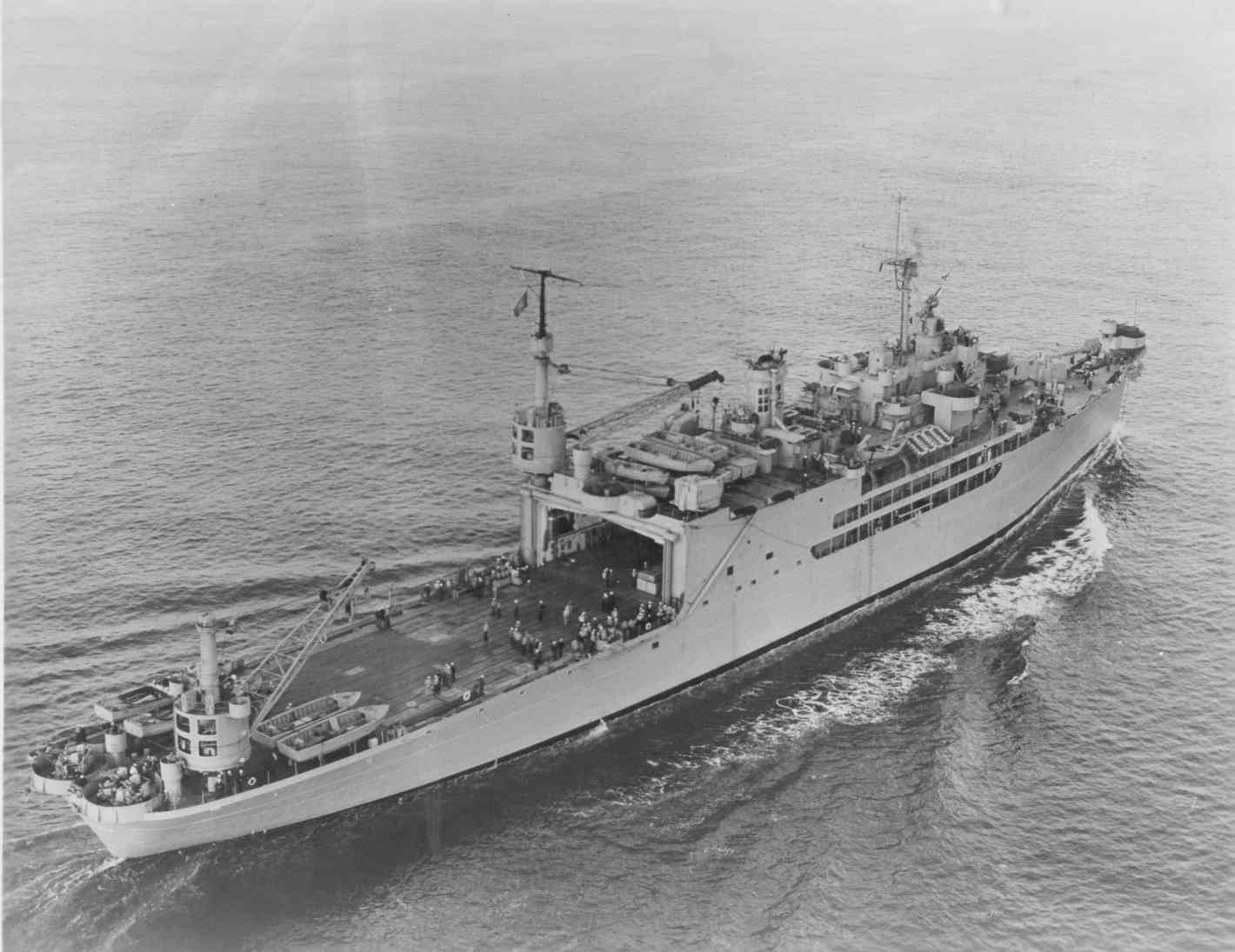
The ship below is the one I served on during my tour of duty in the Korean War. I was assigned to the ship and went aboard at the Alameda Naval Base in Alameda, California, the second day after being recalled to duty. I was still aboard the day I was released at San Diego, California — 16 months later. The name of the ship was the USS Pine Island, AV-12.
I was very surprised to be released as soon as I was. I thought the Chinese would enter the war and it would last ten or more years. As you know, the Chinese did not officially enter the war, which is the primary reason it ended when it did.
I had gotten married in April and received my notice to report for duty at the end of July that same year. My son Mike was born while I was in the North China Sea, between China and Korea, aboard the ship. Except for a brief stay at the port of Inchon, Japan, the Pine Island never entered a harbor or tied up to a pier from the time we left San Francisco until our return to San Diego. We received all of our supplies while either anchored or underway at sea.
The Pine Island was a seaplane tender, meaning it served as a floating service station, maintenance facility, and command center for surveillance flights over Korea and the Chinese mainland by our fleet of patrol planes. There were about 25 four-engine PBM seaplanes attached to the ship. During our time in the North China Sea we lost more than half of them — some over enemy territory, some to weather, some to mechanical failures, and some to human error. Just taking off and landing on open water was difficult and dangerous in itself.
Generally speaking, takeoffs and landings were done in the lee of an island or on the open sea, which made them even more challenging. To aid in takeoff the Navy used a device called JATO thrusters — disposable rocket canisters attached to the sides of the flying boat's fuselage. As the plane accelerated across the water during its takeoff run, the JATO rockets were ignited, providing a powerful boost that propelled the plane into the air in a much shorter distance, making the operation considerably safer.
The ship had a crew of around 3,000 people — a large number for a vessel of that size. The reason was that we carried flight crews for the aircraft, airplane maintenance crews, the ship's own personnel, and an administrative staff. The Pine Island was also a flagship, meaning an admiral was aboard to supervise the ships and planes involved in our surveillance activities.
Because the ship was a support vessel for air operations it had many conveniences not found on other ships of comparable size — a full-sized hospital including dentists, three Navy chaplains holding religious services for the various faiths, a barber shop, a cleaner and laundry. Movies were shown on the hangar deck each night, though the problem was that there were only a few films, shown over and over. I was an infrequent moviegoer. There was also a ship's store much like an Army PX, where we could purchase imitation ice cream, which was a genuine delight.
So life was better than on a smaller ship with fewer crew. That said, depending on how close you were to the enemy, boredom and a general feeling of dread and uncertainty were the biggest concerns in a situation like ours during the Korean War. The fact that I had just gotten married and had a son born while I was away — plus the thought I might be gone for years without seeing my family — were more of a worry than any fear of the enemy.
The two large cranes on the ship could lift a plane directly out of the water and set it on the deck for maintenance, repair, and servicing. If you look at the photograph you will notice a large number of small boats loaded on the decks. These were used to shuttle crews and supplies between the ship and the planes riding on the water.
You will also notice in the photograph a large enclosed area with doors open. The planes were moved from the open deck into that enclosed area for major repair and servicing. The doors don't appear wide enough for the wings to fit fore and aft, and I honestly cannot remember exactly how that was managed — but I do know the planes were brought inside.
The ship had approximately the same armament as a destroyer. I am sometimes asked whether we ever fired the guns — the answer is yes, though we were never in any great danger. Weather was actually more of a hazard to the ship than the enemy. It was during my time on the Pine Island that we were caught in a hurricane.
The Hurricane
During the hurricane we were underway at sea and passed directly through the eye of the storm. We had tried to avoid it by going around the north end of the island of Formosa, but the storm changed course and we were trapped in the heart of it.
My most vivid memory of the hurricane was how quiet it was inside the eye. The eye was probably 10 to 20 miles in diameter with not a breath of air moving. Outside the eye the winds were blowing in excess of 125 miles per hour.
That was one of the most memorable events of my time at sea — which in total lasted about five and a half years, counting my time in the Navy and the year I spent in the civilian Merchant Marine service.
My life in the Navy during World War II is something I hope to write about at more length. I spent just about three and a half years at sea during that time. The trip I made around the world — leaving San Francisco and returning to New York in the Merchant Marine between my tours in the Navy — was also eventful, lasting almost a year. I will try to write a few pages on it one of these days.
The North China Sea, Winter 1950
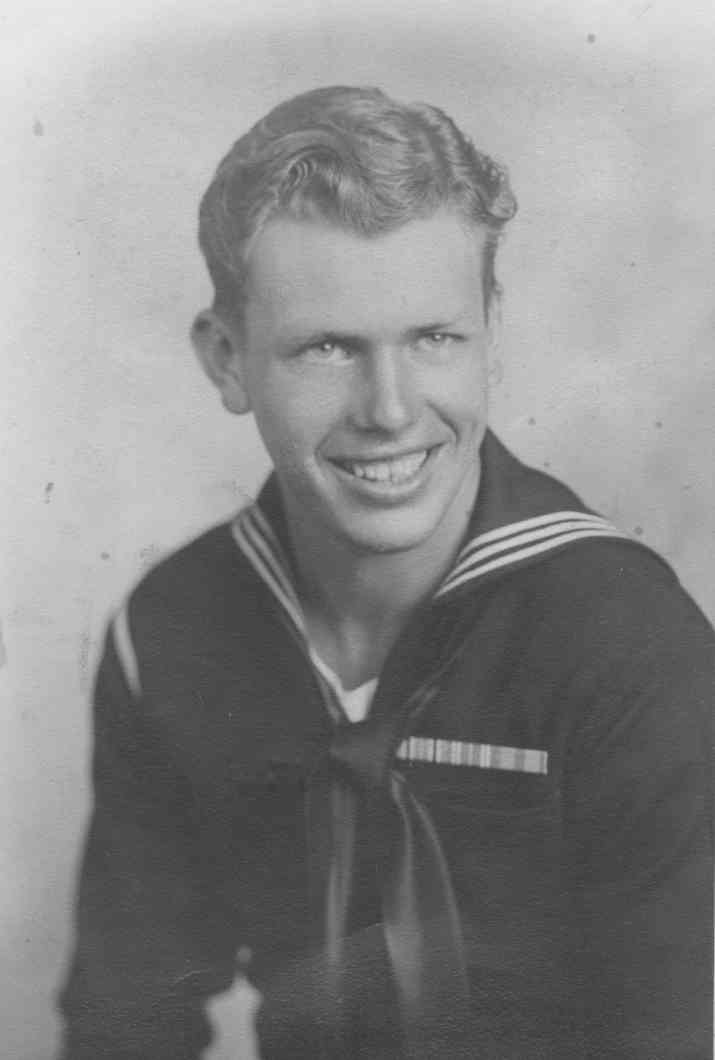
The photograph below was probably taken in Hawaii when I was about 18 years old.
The photo below was taken aboard the Pine Island in our gunnery office. The triangular-shaped rack on the wall is a loading rack for filling 20mm magazines for an anti-aircraft gun.
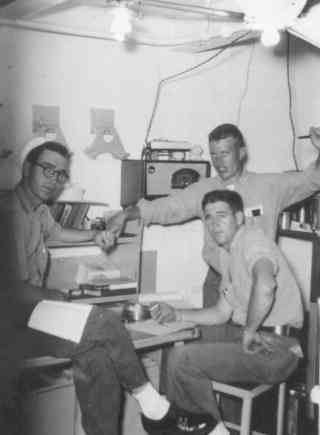
This is a photograph taken on the Pine Island — that is me in the background. I look younger than 25. The man seated on the stool is Billy Smith, a First Class Gunner's Mate, which was also the rank I held. The person with the horn-rimmed glasses is Dave Exley, and he is the greatest hero I ever served with.
He may not look like a hero, but Dave was awarded the Silver Star with an Oak Leaf Cluster for gallantry in action. For those unfamiliar with military decorations, the Silver Star is the third-highest award a serviceman can receive, just below the Distinguished Service Cross and the Congressional Medal of Honor. Dave was also one of the finest people I have known — a true friend.
Dave was the kind of person who loved doing things others would never think of. For example, he once proposed to the ship's captain that he and I use scuba diving gear to attempt to salvage a seaplane that had sunk just off our stern. The captain vetoed the idea, partly because the ship lacked the necessary equipment for a successful salvage — and partly because we left the area before we ever had a chance to try.
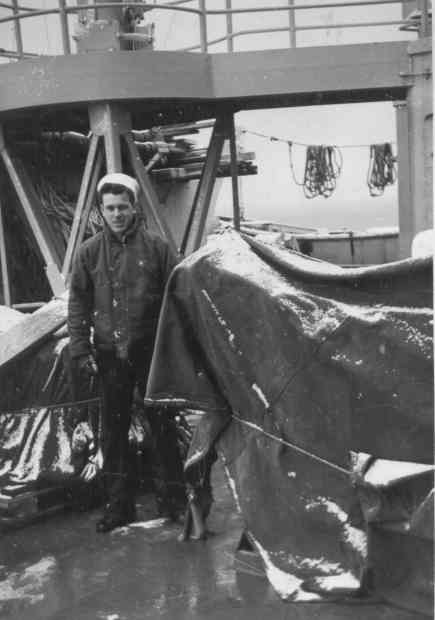
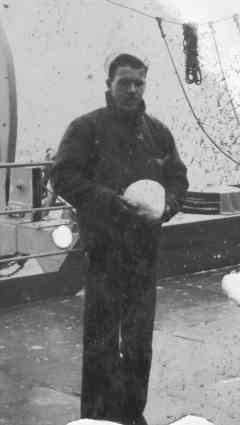
World War II
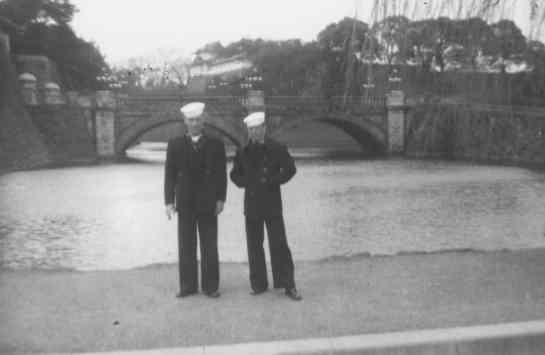
The photographs below were taken during World War II.
Japan After the War — Hiroshima and the Ski Lodge
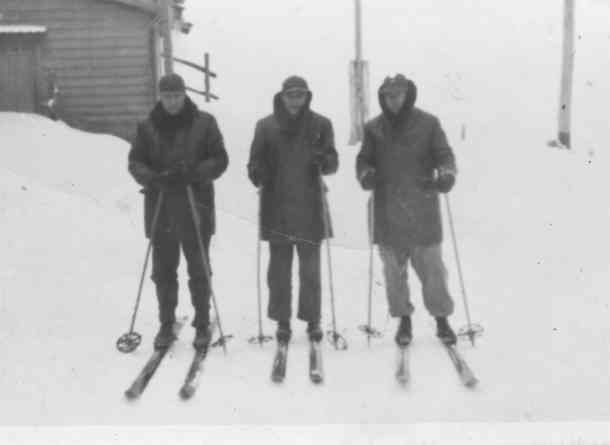
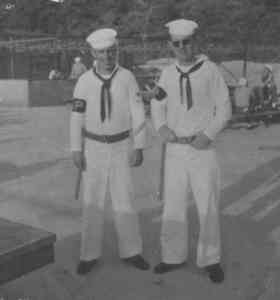
The photograph below was also taken in Japan just after the end of World War II, on a skiing trip to northern Japan. This was shortly after we had toured Hiroshima — when it was likely still dangerously radioactive. George noted with dry humor that if the photograph below had been taken at night, we would most likely have been glowing. I am the one on the right.